Über 100 Tipps bzw. „hacks“ zu verschiedenen productivity Themen:
Kategorie: Allgemein Seite 87 von 103
… is another one of these, you know, cool videos by Taylor Mali:
… in einer schön gestalteten online Ausgabe mit Original-Illustrationen. Besonders gut gefällt mir der „Dual language“ Modus.
In den vergangenen zwei Wochen habe ich gleich zwei Fortbildungen zum neuen P‑Seminar in der neuen bayerischen Oberstufe mitgemacht.
… sind eine besondere Form von Competitions, die oft den Abschluss einer creative writing Aufgabe bilden.
Wenn schlechte Schüler beim Lehrer nachfragen, wie sie denn ihre mündlichen Noten für Unterrichtsbeiträge (UBs) verbessern können, bekommen sie meistens die lapidare Antwort, dass sie „halt besser mitarbeiten“ sollten. In manchen Fällen ist dieser Rat sinnvoll, in vielen / den meisten (?) Fällen aber nutzlos, weil der Schüler im Unterricht eh nicht richtig mitkommt und viel zu viel Angst hat, sich durch blöde Beiträge lächerlich zu machen. Viel besser finde ich es deshalb, wenn Schüler einen UB (UnterrichtsBeitrag) SIMulieren.
… is quite simply the most interactive and sophisticated version of Romeo and Juliet ever created. Use this as a study guide and teaching tool. Read the play, read its English source texts, read critical materials on the play, explore Shakespeare’s vocabulary, and experience a full range of multi-media associated with the play.
Phantastisch, das Beste was ich jemals in dieser Art gesehen habe.
Wir neigen häufig dazu in unserem Job nur Schlechtes, Misslungenes und Belastendes wahrzunehmen und die schönen, befriedigenden Momente des Paukerlebens auszublenden. Wann bist du, bzw. wann ist zuletzt ein Kollege ins Lehrerzimmer gekommen und hat von einer gelungenen Stunde, einem erfolgreichen Gespräch mit einem Schüler oder sonst etwas Positivem erzählt?
Als einer der letzten überlebenden Ritter der TAFELrunde lege ich natürlich großen Wert auf eine saubere Tafel:
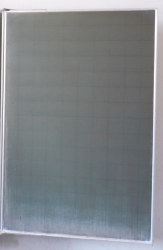
Ohne Abzieher (squeegee) geht tafelputzmäßig schon mal gar nichts:

In einer der ersten Stunden demonstriere ich korrektes Tafelwischen und ‑abziehen, das Ganze natürlich gleich auf Englisch:
You take the sponge, go to the sink, open the tap and make the sponge wet. Then you squeeze it so that it doesn’t drip any more and clean the board. After that you take the squeegee, move it horizontally and hold the sponge under the squeegee so that it catches the water. Do NOT move the squeegee vertically otherwise there will be ugly stains on the floor.
Das Entscheidende ist dabei die WAAGRECHTE Bewegung des Abziehers. Nur sie ermöglicht es, die runterlaufende Soße mit dem Schwamm aufzufangen. Es wird mir ein ewiges Rätsel bleiben, warum selbst Kollegen, die ansonsten großen Wert auf ein sauberes Klassenzimmer legen, unverdrossen den Abzieher mit großem Schwung senkrecht von oben nach unten führen (lassen), so dass die ganze Kreidesoße auf dem Fußboden landet, wo sie häßliche Flecken bildet und darüberhinaus im Laufe der Zeit das Linoleum angreift.
Was sagt / ruft / brüllt man eigentlich auf Englisch, wenn man kurz vor Verlassen des Klassenzimmers noch den „Tafeldienst“ an seine Aufgabe erinnern will? Paul Webster, ein britischer Muttersprachler, meint dazu:
I don’t think it is common for pupils to be given this job in Britain. I think the teacher usually cleans the board. On an ad hoc basis, the teacher might say, „Peter, clean the whiteboard for me please, will you?“
Blackboards in Britain are cleaned with a ‚board rubber‘, which is made of a thick pad of felt attached to a piece of varnished wood about 2″ by 7″.
Water is not involved, and British classrooms – other than science labs – do not have sinks. The board is more thoroughly cleaned by the caretaker or cleaning staff from time to time. British schools have never had the type of height-adjustable blackboard used in Germany, although British blackboards often do have folding panels at each side. One common type is the roller board, especially in maths rooms and science labs. This type has flexible panels, some of which are plain black while others are are squared. One of the panels could be a whiteboard or projection screen.
However, blackboards have been on the way out for many years, and in recent years British schools have been busily going over to interactive whiteboards.
I only really remember the following from primary schools. Pupils who do classroom jobs can be called ‚the x monitor‘, where x stands for the name of the job they have to do – e.g. a litter monitor would be in charge of making sure there was no rubbish lying around.
So your pupils could be called ‚blackboard monitors‘ (or ‚whiteboard monitors‘). Alternatively you could just call them ‚board cleaners‘. At the end of the lesson you could say, „Board cleaners, (time to) do your job.“ Another relevant expression might be, „Who’s on board cleaning duty this week?“
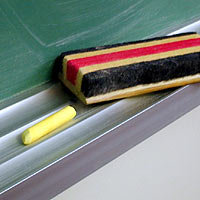
Und „Kreideablage“?
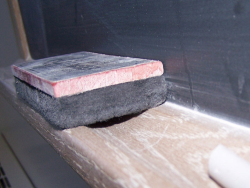
I do not know of any special term for „Kreideablage“. If pushed, I would say chalk rest or chalk shelf. However, in class I would say to a pupil, „Don’t put the chalk on my desk. Put it back where it goes.“